No, I’m not trying to pimp a specific brand of cellphone and its accessory, but Say hello to iPlate is a awesome DIY project where the author uses wet collodion glass plate, and old photographic process, to make a personalised iPhone cover. This could work for any device that uses glass, or something that can be replaced by a glass plate.
Category: Links
Digitising film with a DSLR
Scanning Film Negatives With A DSLR – A Maker’s Guide by DIY photography.
Right now I can get higher resolution and better image quality that what street labs give you on CD.
It is not just a matter of photographing the film with a digital camera. There is must much work behind the scene, and given the price and rarity of film scanner, and the performance of even high end flatbed scan with film support like Epson V600 and V700, it might be worth it. I have always thought I good do it that way, but never went the extra effort to actually do it properly. It is probably way easier with black and white.
Remember, slide duplication was done that way, albeit with a specialised duplication film that had some very specific characteristics.
When I build one of these rigs, I’ll let you know.
Fujifilm X-Pro1 8000 frame user review
Prophotonut: Fujifilm X-Pro 1 ~ 8000 frame user review, by Damien Lovegrove, where he took the camera on a trip.
The X-Pro1 is a camera that I believe is best suited for street, travel and portrait photography. It’s not at home in a flash lit studio and it’s not fast enough for any sort of action photography. It’s definitely a niche camera and one I will love using on a daily basis.
Fujifilm film discontinuation
Via the photographblog, Fujifilm to discontinue Fujichrome Velvia 100F in 35mm, 120 and 4×5 formats and Velvia 50 in 4×5 and 8×10. Last shipment in December 2012 for the UK.
This is sad, even for the Velvia 50 at it represent one of the best colour film today for landscape. The market for reversible colour film is shrinking even more.
Zack Arias X-Pro1 test in Mumbai
Before the release of the camera, Zack Arias tested the X-Pro1 for Fujifilm in Mumbai. While this is a promotional video for Fujifilm, just watch Zack working, and the images he made:
I also linked to Zack reviews in the past.
Why your GPS might not work in China
You might wonder why your camera GPS might not operate in China. Stefan Geens explain us why Panasonic, Leica, FujiFilm, Samsung and Nikon censor their GPS cameras. The tl;dr version is to respect the law China about GPS devices sales and usage. Note that they are not the only manufacturers.
I don’t know if my Holux GPS would work in China, but I bought it from Hong Kong.
“Some Thoughts on Digital Camera Lifespan”
Minh Thein on Petapixel has some thoughts on digital camera lifespan”
In the film days, the camera body and lenses lasted a long time; you invested in glass, got a decent body — one that fulfilled your personal needs as a photographer — and then picked the right film for the job. In that sense, image quality differences between brands were down to the lenses and the photographer.
[…]
Bottom line: the camera body now plays a much more critical role in the imaging chain because it also contains the “film”, and this isn’t something you can change when the equivalent of a new emulsion is released.
Before you increased the technical image quality with better lenses and better film. A 1950 Leica M can use modern Leica glass and modern film. Still the same camera body.
Also another point Thein raise is how digital camera are obsoleted by unavailability of things like batteries, and the risk of losing ones archive with file format incompatibilities, *cough* RAW *cough* , as well as storage solutions.
This is something to be thought about with our society being more and more throw away. I wonder if the amount of e-waste isn’t worse than the chemicals used for film processing and printing.
“I Am NOT Saying the Fuji X-Pro1 Sucks…”
Ctein at The Online Photographer is not saying the Fuji X-Pro1 sucks, but he is saying that several of the flaws from the camera make it a bad choice for him.
The eye level viewfinder is a letdown. I’m left-eyed, which means whenever I use that viewfinder I put a great big greasy nose print in the middle of the LCD screen. LCD screens are my preferred way to work.
Same problem with rangefinder – and actually most cameras since they are all designed for right handed and right eyed people. But what make the Fujifilm X-Pro1 attractive is the optical viewfinder. Given that his preferred way is the LCD screen, it is already moot.
There’s no way to zoom in by more than a factor of two when reviewing RAW photographs. That won’t tell me if my focus is correct, if there’s subject movement, or how noisy the photograph might be. It’s barely enough to judge facial expressions.
[…]
If I capture RAW plus JPEG, I can zoom all the way in. It’s kind of dumb, and I just waste time later throwing away the JPEGs (I have no use for them), but it works.
That’s unfortunate and I indeed wish Fujifilm would fix these.
New X-Pro1 lenses roadmap
Yesterday, Fujifilm gave the roadmap for the X-mount lenses in 2012 and 2013.
For fall 2012, a 14mm f/2.8 wide angle (equivalent to 21mm) and a “standard” 18-55mm (equivalent to 27-84mm) zoom with stabilisation and wide f/2.8-4 aperture.
For 2013, more primes and zoom: the anticipated 23mm f/1.4 (equivalent to 35mm), a 27mm f/2.8 pancake (41mm equivalent) and a 56mm f/1.4 (84mm equivalent), as well as a very wide angle 10-24mm f/4 zoom lens (15-36mm equivalent) and a 55-200mm f/3.5-4.8 (83-300mm equivalent).
No detail on pricing or exact availability, but this looks to be a promising commitment from Fujifilm on the X-Pro1 system. Here is the roadmap as published by Fujifilm:
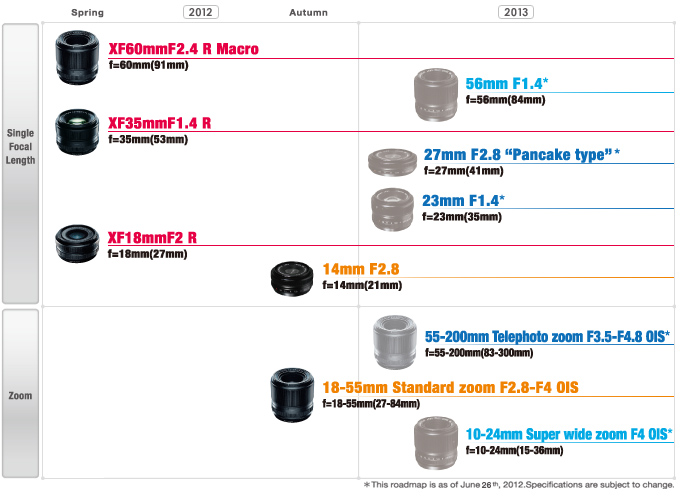
Source Fujifilm (archived from the original)
Mirrorless: what is the right price?
Sansmirror raise the question What’s the Right Price? when it comes to mirrorless cameras.
Most of the new higher-end mirrorless cameras are more expensive than low-end DSLRs.
Also he mention that the Olympus E-PL1 is still on sale for much less. Not sure whether it is because of stocks (ie over production) or just Olympus trying to drag new customers in with a cheaper model, as Panasonic hasn’t really done that. This lead us to believe that these cameras don’t sell as well as they might have wished.