Harman Phoenix is back as an 125 ISO film. Currently only in 35mm, it is just the original Harman Phoenix (not Phoenix II) in a new packaging, DX coded to 125 ISO. The new ISO is based on feedback from photographer that it looked better exposed +2/3 stop. Will also be available in 120.
Another change is that officially it can be processed in E-6 or ECN-2.
I have just gotten my only exposed roll of Phoenix back from the lab. More later.
A great introduction to shooting panoramic on film. It’s not about stitching, it’s not about digital. It’s about 35mm film and various types of cameras. From the Fujifilm T-X1 / Hasselblad X-Pan, shooting natively 24x65mm, to the compact point and shoot Minolta P and Rioch R1, that crop inside a 24×36 frame, by way of the Horizon, Noblex and Widelux with their rotating lenses. What all these cameras have in common is that the image produced is panoramic, ie with an aspect ratio larger by 2:1, and that it is either covering the whole film, or masked ; you don’t crop in post processing.
The article goes on a complete comparison of field of view, aspect ratio, viewfinders, etc. This is all about what the writer has personally used, still favouring the Fujifilm.
A Nikon Z9 Made it Aboard the Artemis II Moon Mission at the Last Minute — In addition to the D5, the crew insisted to bring also a Z9. These are already in use on the ISS. The Z9 is also the basis of the Handheld Universal Lunar Camera (HULC) that will be used on the Moon, like the Hasselblad 500EL were over 50 years ago. Note the article is incorrect on the mission. Unlike stated, the Moon landing mission will be Artemis IV, and not before 2028, as per the schedule change 27 February.
Kodak’s BIMAT System — From the wayback machine since the blog has disappeared. A summary of the BIMAT Kodak film processing system that was used in the Lunar Orbiter Program in 1996 and 1967 to take pictures and develop them in space. The system was classified until the 2000s as it was also used for spying. The program was designed to identify landing site for the Apollo mission and its landings.
Lunar Orbiter — A more detailed article on the orbiter program.
DIY
IDENTIDEM.design Cameras — Not exactly DIY but not industrially produced but 3d printed medium format cameras, with a LIDAR, using Mamiya Press lenses. CA$1612 bring your own lens.
In 1975, a young engineer in the company that made Kodak film took the first picture on a handheld digital camera. Photography would never be the same again.
In a short summary, the first digital camera was invented at Kodak by Steve Sasson. Not because Sasson was asked to do it, but because, as a new hire, his first assignment was to checkout these new CCD chips. The bulky black and white camera took 100×100 pixels picture stored onto a cassette tape, to view the tape was read back for the image to be displayed on a TV. And business people always so this as a shift in the business if it every took. But in 1975 this was definitely not ready for anything, It needed hundred times more pixel to match even Instamatic 110 — which was the smallest format, before Kodak Disc.
Kodak had the future in their hands, but didn’t know what to do. It’s not that they did nothing, but what advance they had, they lost it as the competition caught up. After producing the first DSLRs with Nikon and Canon, making a good number of point and shoot cameras, and creating with Olympus the Four-Third format, they lost to the market and filed for bankruptcy in 2012, at which point they sold of a lot of business divisions, including the sensors.
After having emerged from bankruptcy over a decade ago, Kodak remains one of the few film manufacturers left in the world, while a lot of Kodak branded products are just that: branded. Fortunately Kodak seems to want continuing making film in a market that has completely shrunk, and for which its main competitor, Fujifilm, mostly withdrew.
In the continuation of Eastman Kodak bringing back the films from Kodak Alaris into their own umbrella, the latest “victims” are Portra and T-Max. While the brand will not be continued, both line will be renamed.
Long live to Ektacolor Pro and Ektapan (via Petapixel, as I’m not on the Eastman Kodak mailing list).
Ektacolor Pro will be in 160, 400 and 800 ISO, much like Portra. The 800 ISO film will cost more. Ektapan will be in 100, 400 and 3200 ISO, like T-Max. Both will be available in 135 and 120. Not sure yet about sheet film.
Now the only thing that is missing is that 800 ISO colour film that is found in the disposable cameras.
Petapixel has a summary of the update video about the WideluxX by SilverBridges, and the unboxing of the functional prototypes by Jeff and Susan Bridges.
This is really taking shape, and it’s probably the most exciting film camera revival.
Harman Technologies has released the Harman Switch Azure film. A colour switched experimental film, not dissimilar to LomoChrome Turquoise. Like the Harman Red, it is based on Harman Phoenix. It is available in 120 and 135 and is rated 125 ISO.
I was having a conversation about a back for a Mamiya RB67 camera to shoot Instax film. The broad idea is to have a better Instax camera than what Fujifilm has to offer.
The Fujifilm Instax cameras are all designed to be simple point and shoot. They work, but really are not flexible if you want a bit more control on the images. The framing is approximate at best, the exposure not always right, and you can’t get shallow depth of field when the lens opens at f/12.7 (Instax Mini), which also, despite the film being ISO 800, make it harder to use in low light. Fujifilm other alternatives are the Evo series that are digital cameras (small sensor) with built-in Instax printer. Which you can get with your phone.
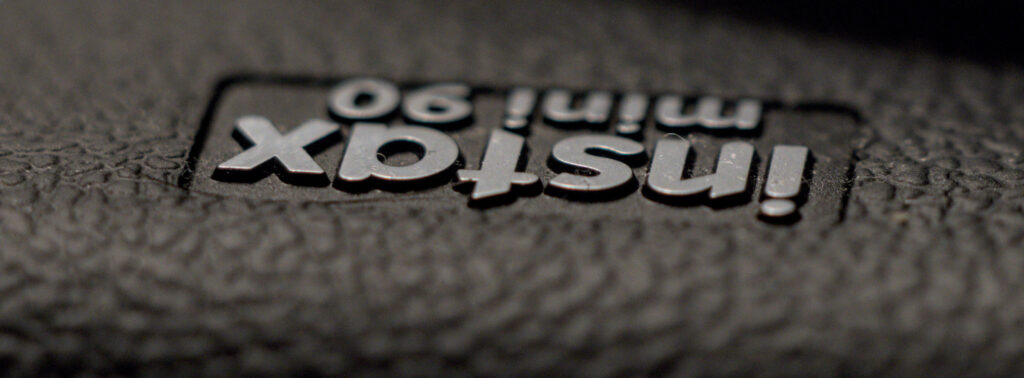
Insta Mini 90 closeup
I do have an Instax Mini 90. When I got it it was the most advanced Instax Mini camera from Fujifilm. With a “retro” look amd the few shooting mode, including being able to disable the flash it was the best Fujifilm had to offer. It remains that the Mini 90 uses the same lens as the cheaper Instax Mini and still offer little control over the picture taking.
In the past Fujfilm produced some very good medium format camera, so I wished Fujifilm used their know how to build a way better Instax camera, but this is unlikely to happen.
Let’s have a look at the options. There are two categories: camera that shoot one of the three Instax format, and backs that adapt Instax on existing camera. The latter isn’t a new concept and it was widely used by professionals to shoot Polaroid peel apart as part of their workflow to check for exposure.
This is deliberately about Fujifilm Instax and not about instant photography in general, so I deliberately omit Polaroid: it is about the medium, and the medium is Fujfilm Instax.
Instax Film
Fujfilm Instax film is an integral instant film, and comes in 3 different sizes. Mini whose picture size is 62x46mm, Square that is 62x62mm and Wide that is 62x99mm. First released in 1998, Instax Mini is the most common format, and easy to find, at least here in Canada. There are two emulsion, always 800 ISO: colour and monochrome (B&W). Instax Square was released almost 20 years later in 2017. “Integral” mean that each frame contain the original exposed film, the developer and turn into the final print. Unlike “peel apart” that required to peel apart some of the film to reveal the final print.
From the standpoint of film camera format, Instax square is close to the iconic 6×6 format shot by Rolleiflex and Hasselblads, while Instax Mini is close to 645, and Wide is wider than a 6×9. These size constrain the kind of camera that can be adapted to use Instax film.
Cameras
There are a few options available from manufacturers like MINT, NONS, Lomo, and maybe TTArtisan.
MiNT
MiNT is a small camera company out of Hong Kong. While they started with Polaroids refurbishing, they are known for having designed the Rollei 35AF. MiNT have 3 cameras that are compatible with Instax. In the high end of the price range.
The Instantkon RF70, a foldable rangefinder camera that take Instax Wide. At CA$1320, it offers a 93mm f/5.6 lens. A smidge wider than Fujfilm Instax Wide 400 it is way faster allowing a shallow depth of field. It also allow exposure control that Fujifilm doesn’t.
The InstantFlex TL70 is a TLR that take Instax Mini. At CA$570 it offers a f/5.6 lens with a waist level viewfinder for focusing and framing, and an aperture priority exposure mode.
The InstantFlex TL70 Plus, is the younger sibling of the TL70 that takes Instax Square. At CA$1070 it offers the same as the TL70, but in square format, with an added shutter speed control.
NONS
NONS is another small camera company based in Shenzhen I talked about previously. They have two SLR camera the SL645 that take Instax Mini, and the SL660 that take Instax Square. At US$400 and $500 without lens, they offer a flexible solution with adapted lenses in Canon EF (passive), and with adapter, Nikon F, M42, Pentax K or Contax CY mounts. There is also the SL42 that is no longer produced.
NONS also make some backs, see further down.
Lomography
Lomography is also in the game with cameras for all 3 formats. The higher end cameras have glass lenses. What they all have in common is that they have a viewfinder that is not favourable to accurate framing, and all have optional accessories for “creative” uses, like lens adapters or gels. There are also various cosmetic editions to match your fashion style or personality.
The Lomo’Instant Wide and Lomo’Instant Wide Glass with an 90mm (35mm equivalent) f/8 lens are faster and wider than the Fujfilm Instax Wide 400. At respectively CA$229 and CA$379 they offer more flexibility than Fujifilm, the latter also having a glass lens offer a higher step in image quality, auto exposure and PC flash sync.
The Lomo’Instant Square Glass offer a 95mm (45mm equivalent) f/10 glass lens. Longer but a bit faster than the Fujifilm SQ1, it also offers more controls and auto exposure, starting at CA$169. Some kits offer an adapter to be able to also use Instax Mini, for CA$30 extra (CA$199).
The Diana Instant Square brings Instax Square to the legendary Diana family of camera. Starts at CA$179, with a 75mm glass lens option at CA$189.
The Lomo’Instant Automat Glass offers, for Instax Mini, a wider 38mm (21mm equivalent) glass lens at f4.5, with auto exposure for CA$269. The less expensive Lomo’Instant Automat offers a bit faster and longer plastic 60mm (35mm equivalent) f/8 lens for CA$209.
The Lomo’Instant is the most budget friendly Instax Mini camera from Lomography, at CA$89. Fitted with a 27mm f/8, it doesn’t have auto exposure as it only has a single 1/125s shutter speed.
Escura
The escura instant60s are 100% hand powered Instax Mini camera, with a 60mm f/12.7 lens. As of writing they are listed as out of stock.
Mercury Universal
Mercury Universal offers two built to order Instax Wide compatible camera, that can take any of the lens that can be adapted in their system. The mechanism are the same they offer in the backs mentioned below.
Backs allow using Instax on existing medium or large format cameras. These are more economical if you already own a compatible camera and likely offer the best image quality. They are a niche of a niche market product, so they mostly are small production runs of hand made products.
NONS
All the NONS Instant Back are motorized.
The NONS Instant Back for RZ67 offers an Instax Square back for the Mamiya RZ67, for US$319, and one for the Mamiya RB67 for US$309.
For Hasselblad, NONS has two different backs. The older NONS Instant Back produce images with a black border due to a slightly smaller image gate, and the image is oriented sideways. US$279. The newer NONS Instant Back H1P introduce some spacer to correct the image size, and also orient the image like Polaroid: the wider side of the frame is down. US$349.
Mercury Universal offers a complete camera system, and, in addition to their Instax Wide camera, they have a set of Graflok backs for Instax.
Part of their offering are two motorized Graflok backs to use Instax wide, one in 45 and one in 23, for respectively CA$730 and CA$765. Both of them push the focal plane 30mm, limiting the cameras that can use them. They are built on top of modified Fujifilm development units.
Mercury also offers an Instant Mini back Graflok 23 compatible for CA$417 that is suited for their Mercury 6×9 camera.
Jollylook
Jollylook has a range of backs for various medium format cameras. They are based on their in-house crank powered development units for Instax. Includes Mamiya RB67 and RZ67 (Square), Bronica ETR/ETRS/ETRSi (Mini), Bronica SQ/SQ-A/SQ-Ai (Square), Mamiya 645 (Mini), Mamiya Press (Wide) and Hasselblad V system (Square). At US$169/CA$235 (US$189/CA$263 for the RZ67) they are on the low-end cost.
Jollylook also sells the development units separately if you endeavour to build your on back or camera.
Misc
Frankinstax is an Instax square back for Mamiya RB67 or RZ67. At US$600 it’s in the expensive side. They are hand built out of Fujfilm SQ40 in Denver, CO.
binstax and zinstax are Instax Square backs for Mamiya RB67 and RZ67. Hand assembled to order in Germany, out of a Fujfilm SQ1 with an hand crank for development, they cost EUR350 + VAT (if applicable) and shipping.
Escura makes the Hasselback Portrait for Hasselblad V System, compatible with Instax Mini and Square. Cost US$365.
Transformation
Instant options has a custom service for transforming Instax cameras to use better lenses, or converting cameras to use Instax.
Updated May 2026: Added the NONS RB67 back. Not sure how I missed it in the first place.
The legendary slide film, discontinued and then revived, is now being folded back to Eastman Kodak. This comes after Ektar 100 and Tri-X 400. It’s looking like the whole range of Kodak product is being repatriated from Kodak Alaris. It feel reassuring after learning that Kodak Alaris was being bought by private equity. The were just the exclusive distributor of Eastman Kodak in a deal with the Kodak UK pension, but now it seems that the deal changed and Eastman Kodak is getting it back.